
Or Let’s Dig Into the Slavic Inspiration Behind My Dark Urban Fantasy Novel From the Cradle to the Grave

I’m going to guess you probably heard about the rusalka—a famous East/West Slavic water spirit, similar to mermaids (but not really? but let’s keep this td;lr). I didn’t find the rusalka in Croatia (maybe yet), but I did find something similar—the malevolent water spirits/fairies, who lure people to drown them in rivers. This is a ‘story behind the story’ segment, where I’m going to talk about the vodenkinja, a magical creature from Croatian folklore connected to water. My previous disclaimer when I wrote about krsniks and štrigas stands: folklore is fluid, there can be changes in stories from village to village, sometimes more subtle sometimes more obvious. The main source for the vodenkinja that I used when writing my Slavic fantasy novel From the Cradle to the Grave—and subsequently for this text—is Hrvatska bajoslovlja (lit. translation Croatian Myths) by Vid Balog, illustrated by Patricio Agüero Marino.
“What is a water spirit without its source?” – From the Cradle to the Grave
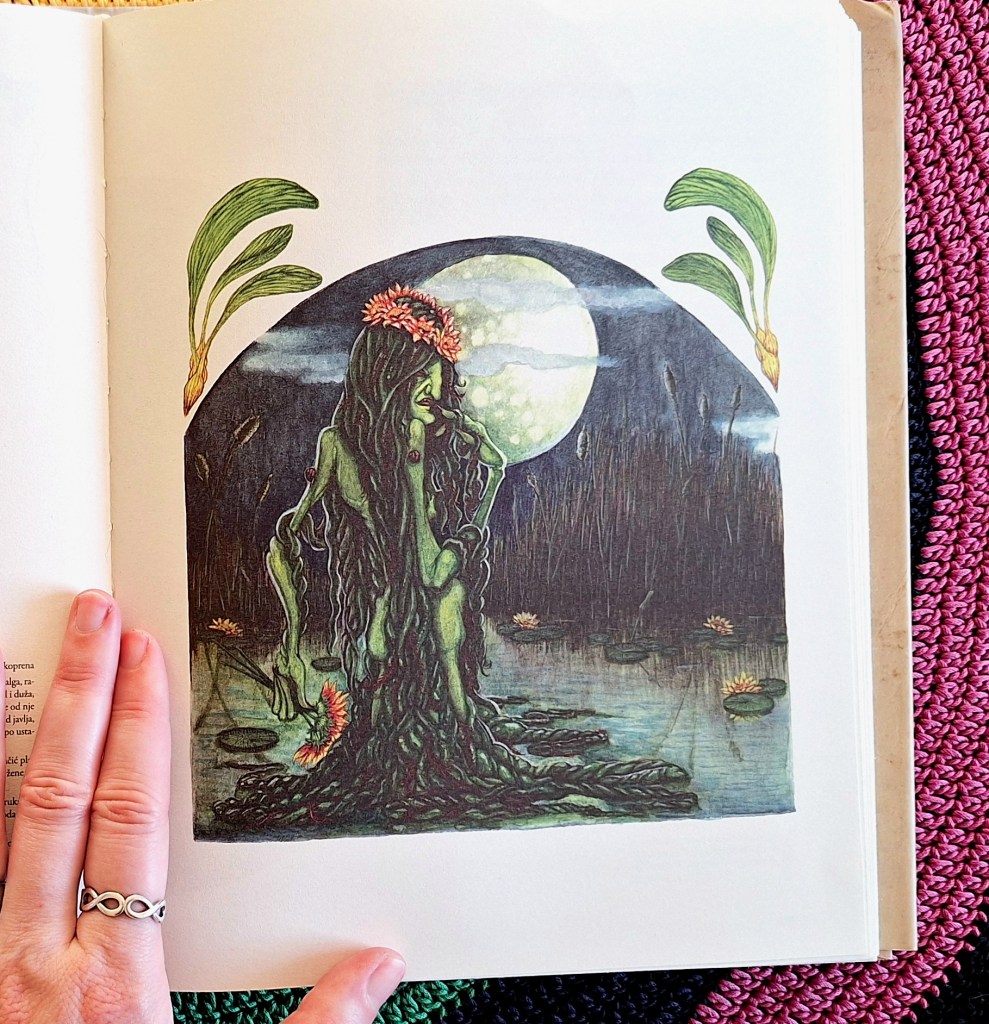
A vodenkinja is a water spirit residing in a river, usually a partner to the male entity vodenjak, but I ignore that part. As mentioned, her role is to lure people to their watery graves. Once drowned, the victim becomes a servant to the underwater kingdom of water spirits. The vodenkinja looks like a woman with green skin and her green hair is decorated with water lilies, river grass, and/or crabs.
I’m absolutely obsessed with Marino’s amazing illustration of vodenkinja in Hrvatska bajoslovlja as this green woman standing in front of tall bulrushes with her lush hair cascading over her body like a waterfall. I blame this illustration as the main reason why I want to write about these creatures. And write I did, on more than one occasion.
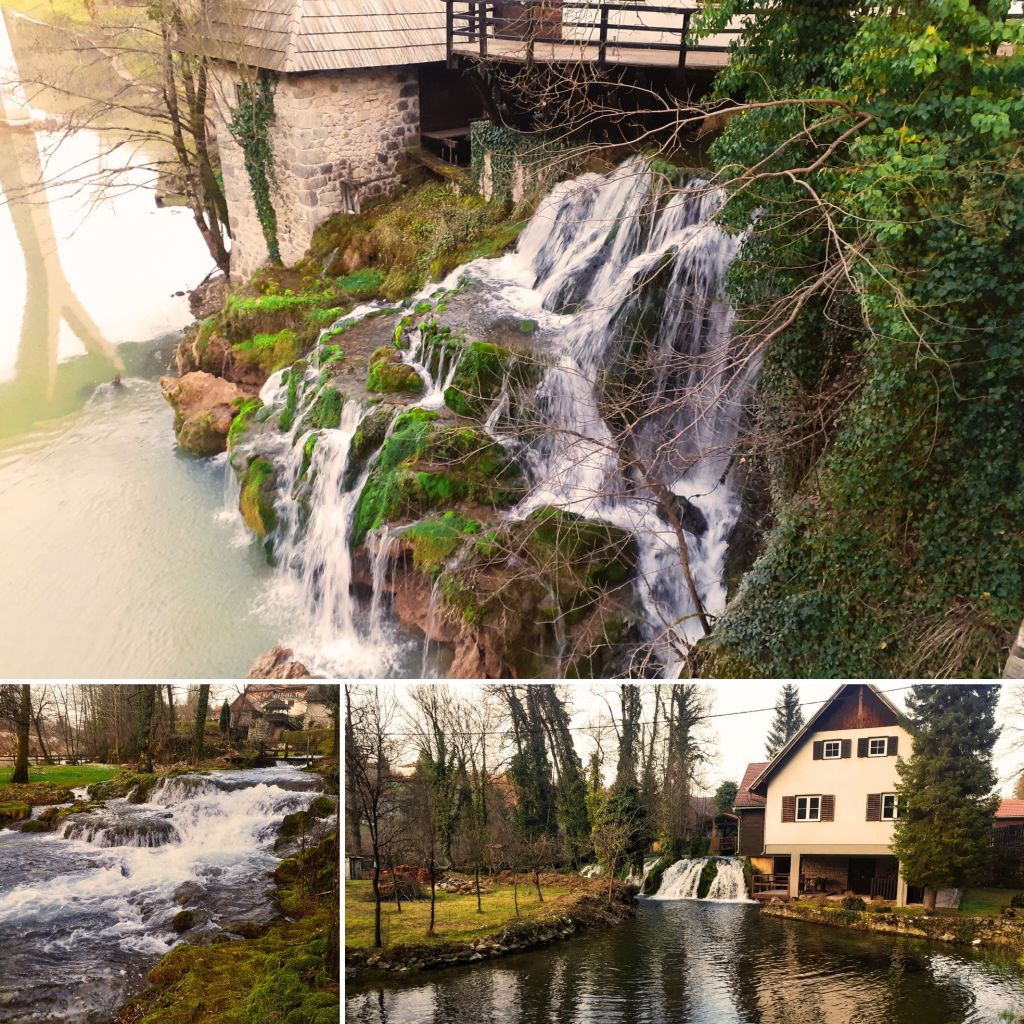
While I was on a research trip for my novel, for the character of vodenkinja in fact, we stopped on our drive at the rustical mill village Rastoke, a real fairy tale place, where the reverberation of the waterfalls was a constant music in our ears, following us on our stroll through the canyon. Enchanted with the village, the mills, and the river, I ended up writing an unplanned short story about two lonely monstrous women hunting on the same territory, one a water fairy—vodenkinja—other a she-wolf. That short story, What Lies Tangled in the River Grass, was originally published in the anthology Folk Tales From The Hinterland (ed. April-Jane Rowan), and recently republished in my second folk horror collection The Lost Treasure Hunters and Other Tales of Folk Terrors.
Coming back to my main reason for the trip, while I was working on my Slavic fantasy novel, I knew I wanted to use the wide variety of magical beings from South Slavic folk tales and myths, and because of the story, I needed them to be from different parts of Croatia. I wanted to include someone from the Lika region, and found a creek that seemed a perfect place for it to be the “birthplace” or “the source” of the vodenkinja character—named Bara in the novel.
I’m talking about the creek called Baraćevac (potok Baraćevac), connected to the Caves of Barać (Baraćeve špilje). I went to visit the caves and the creek, even though it had nothing to do with my novel set in Rijeka City. And to be fair, it had nothing to do with Bara either, except in the sense that in the book she was a water spirit of Baraćevac creek living in Rijeka’s dormitory. You could say that I procrastinated from writing with a road trip, and that would be correct. In the end, I couldn’t even visit the caves, because we had a dog with us, and dogs aren’t allowed in. So, I saw the Baraćevac stream, which was well a… stream, set in the beautiful greenery of the landscape, and that was that. At least we stopped at Slunj which resulted in a short story, so, not complete procrastination, I guess.
Bara’s name was also a word-play. Bara in Croatian means puddle or swamp, and it could be short for Barać/Baraćevac, so what better name for a water spirit of Baraćevac creek?
Since the source of the creek is in the caves, the only thing I decided to use from that tidbit was the fact that I could mix into Bara’s character another creature from South Slavic tales—vüliman (also found in Hrvatska bajoslovlja). The vüliman is a creature from the depths of caves, known for devouring people. And if you’ve read From the Cradle to the Grave, you saw that I used that devouring fact as an in-joke with Bara constantly threatening that she’ll eat someone. Another thing I tried to do with her character was her speech pattern as a point of linguistic characterization. She talks fast and a lot, sometimes even without taking a breath, like a stream flowing in a rush.

And a small piece of trivia for the end: Bara is not the only vodenkinja mentioned in the novel. The other one is Rječina as the water spirit of the Rječina river of Rijeka City. And the fun fact is that Rijeka and Rječina mean river in Croatian. One day, I could maybe write her story too. But not today. Great thing that happens when you do a lot of worldbuilding for one novel is that you can always come back to that setting and write something more, and I love this magical world I created. A lot of potential for even more urban fantasy stories, and even more water spirits to write about. Rijeka City is, after all, built over a lot of underground streams.
“Who knows, maybe it’s not a bad idea for the water spirit to eat the corpse. A dead body is the biggest piece of evidence.” – From the Cradle to the Grave
If you’re interested in queer urban fantasy and Slavic folklore and you want Slavic fantasy right from the source (ha!), filled with various creatures and old gods, From the Cradle to the Grave could be just the book for you. If you haven’t already, check it out.
And if you want to read more about folk tales, get book recs, and updates on my work, sign up for my haunted newsletter.
 Haunted Narratives